Digital Marketing Complete Guide for Beginners in Shimla (2026 Strategy)
Introduction
.png)
If you run a hotel, cafe, local business, retail shop, or freelancing agency in Shimla, you have likely noticed a major shift in customer behavior over the last few years. Today, potential clients and tourists do not simply walk down Mall Road or Lower Bazaar looking for paper signboards or pamphlets. Instead, the moment someone needs a service, place to stay, or professional training, they pull out their smartphone and search online.
This changing consumer behavior makes understanding digital marketing essential for any business owner, student, or entrepreneur in Himachal Pradesh. Having a physical shop or office is no longer enough; you need a strong, reliable digital footprint so that customers find you exactly when they are searching for what you offer. This is why leading platforms like IICEA focus on providing modern digital insights and skill-building strategies to help local brands navigate this transformation.
This Digital Marketing Complete Guide for Beginners in Shimla is designed to give you an end-to-end roadmap for building, managing, and scaling an online presence. Digital marketing is far more than occasionally posting photos on social media or sending broadcast messages on messaging apps. It is a structured, data-driven system that connects your business with the right audience at the right time.
In this comprehensive guide, we will break down all the foundational pillars of digital marketing, explore modern strategies like Local SEO and Generative Engine Optimization (GEO), and show you step-by-step how to grow your brand online.
What is Digital Marketing? (Fundamentals Explained Simply)
At its core, digital marketing encompasses all marketing efforts, strategies, and techniques that use an internet connection or an electronic device. It includes a wide variety of channels, including search engines like Google, social media platforms like Instagram and Facebook, email, websites, and mobile apps.
To truly understand digital digital marketing, it helps to contrast it with traditional marketing methods such as printed newspaper advertisements, radio spots, paper flyers, and roadside hoardings. While traditional marketing reaches a broad audience, it lacks precision and is nearly impossible to track accurately. Digital marketing, on the other hand, allows you to select your exact target audience and measure every click, view, and phone call in real time.
Traditional Marketing vs. Digital Marketing
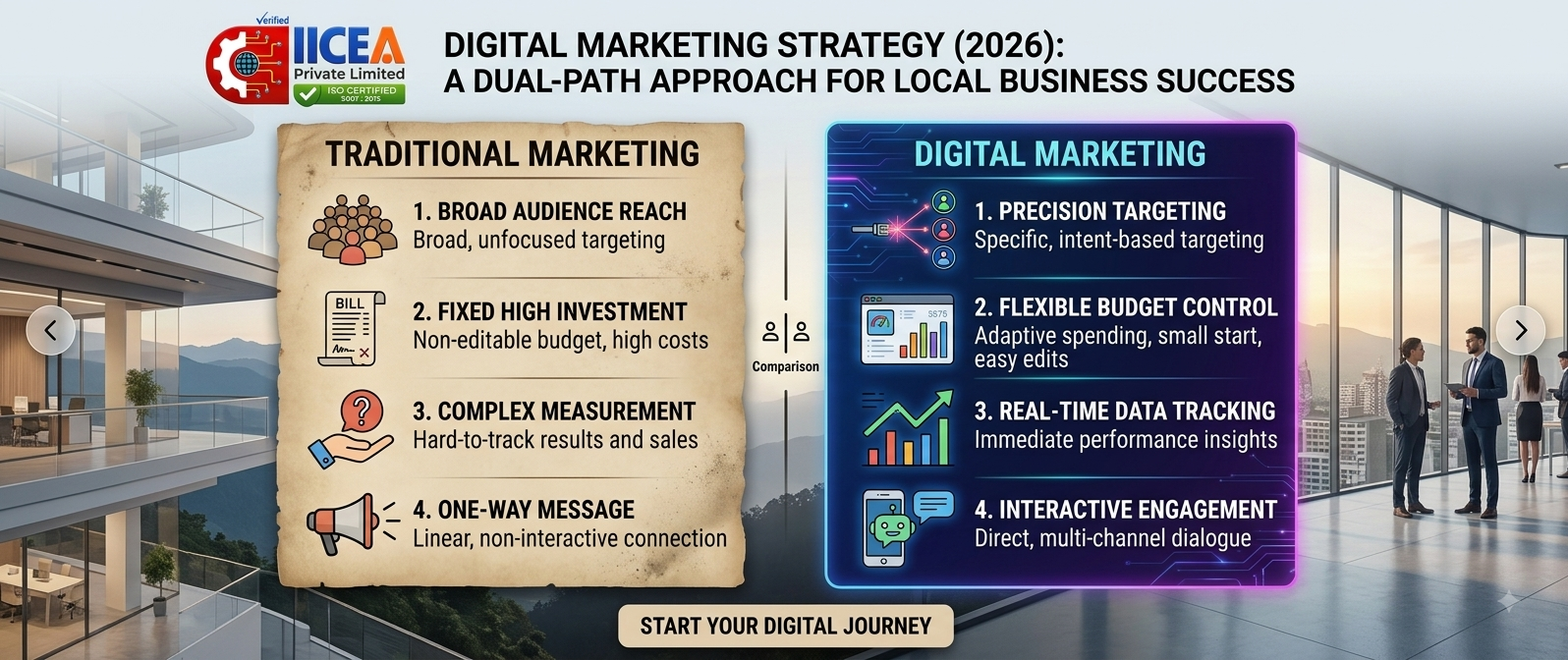
The biggest difference between traditional and digital marketing comes down to who sees your message, how much control you have over your budget, and whether you can track your results.
Traditional ads help you reach a general crowd, while digital marketing helps you talk directly to people who are actively looking for what you offer.
1. Audience Reach and Targeting
- Traditional Marketing: Your reach is limited to a specific physical area, like people reading a local newspaper or walking past a billboard on Mall Road. You cannot choose who sees your ad based on their age, interests, or needs.
- Digital Marketing: You can choose exactly who sees your content based on their age, location, and daily search habits. You can focus strictly on local customers in Shimla or expand your reach across the entire country.
2. Costs and Budget Control
- Traditional Marketing: Print ads, flyers, and billboards require large upfront payments. Once your ad is printed or put up, you cannot edit it, fix mistakes, or change your spending.
- Digital Marketing: You have complete control over your money. You can start with a small daily budget, test different ads to see what works best, and pause or change your campaigns whenever you want.
3. Tracking Your Results
- Traditional Marketing: It is nearly impossible to figure out how many sales or phone calls came directly from a paper flyer or a newspaper ad. You are mostly guessing what worked.
- Digital Marketing: You get clear, real-time data. Free tools like Google Analytics show you the exact number of people who clicked your link, filled out a contact form, or called your business.
4. Customer Communication
- Traditional Marketing: This is a one-way message. People see your ad, but they have to manually write down your phone number or visit your shop to ask questions.
- Digital Marketing: This creates a direct two-way conversation. Potential clients can tap a button to send you a WhatsApp message, leave a comment, or call you instantly from their phones.
Inbound vs. Outbound Digital Marketing
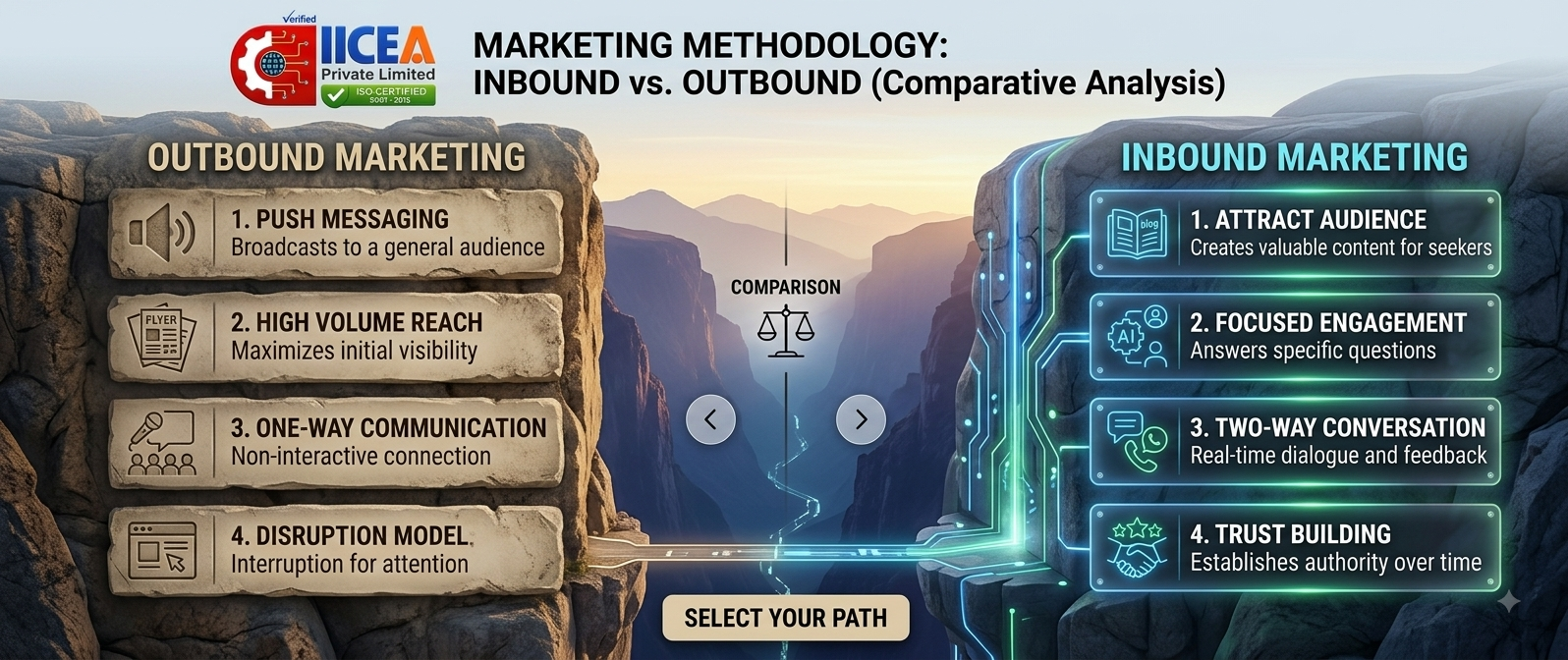
Digital marketing can be split into two main approaches: Outbound and Inbound.
- Outbound Marketing: Involves pushing your message out to a broad audience regardless of their immediate interest. Examples include pop-up ads, display banners, or promotional cold emails.
- Inbound Marketing: Focuses on creating valuable content that pulls prospective customers toward your business when they are actively searching for solutions. Examples include helpful blog posts, search engine optimization, and educational social media content.
For most small-to-medium businesses, educational institutes, and startups, focusing on inbound digital marketing yields a significantly higher return on investment because you reach people who already have a high intent to purchase or enroll.
Why Digital Marketing Matters for Shimla Businesses
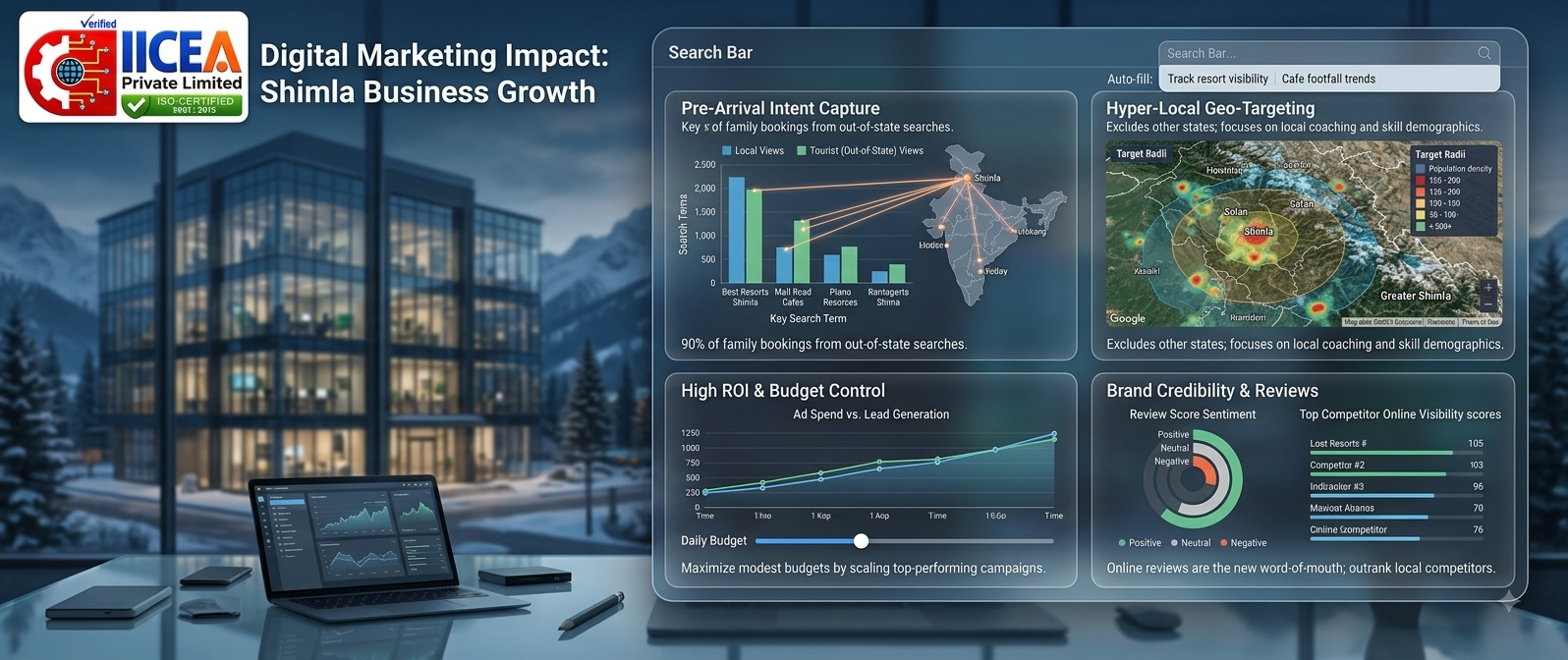
Operating a business or educational center in a unique region like Shimla presents both specific challenges and incredible opportunities. Understanding why online marketing is crucial in this market will help you prioritize your efforts effectively.
1. Capturing Tourist Intent Before and During Arrival
Shimla is one of northern India's premier tourist destinations, attracting millions of visitors every year. Modern travelers plan their trips online weeks before arriving. They search for queries like "best family resorts in Shimla," "top cafes near Mall Road," or "reliable taxi services in Himachal." If your business does not show up in these search results, you completely miss out on this huge stream of revenue.
2. Hyper-Local Geographic Targeting
Digital platforms allow you to show ads or content exclusively to people within a specific radius. For instance, if you run a local coaching center or skill development institute in Shimla, you do not need to spend money showing ads to people in other states. You can narrow your audience down to specific age groups residing within Shimla, Solan, or nearby districts.
3. High Return on Investment for Small Budgets
Unlike traditional billboards or newspaper inserts that require significant capital upfront, digital channels allow you to start with modest daily budgets. You can test campaigns with small amounts, see what generates real leads, and scale up your budget as your revenue grows.
4. Building Brand Credibility Through Online Reviews
Modern customers trust online reviews as much as personal recommendations. A well-maintained online presence with positive customer feedback acts as 24/7 social proof, convincing prospective clients to choose your business over local competitors.
Pillar 1: Search Engine Optimization (SEO) & Local SEO
&LocalSEO.png)
Search Engine Optimization (SEO) is the process of optimizing your website and online assets so that they rank higher in unpaid (organic) search engine results pages on engines like Google. When someone types a question or keyword related to your industry into Google, SEO determines which websites appear at the top.
SEO is generally broken down into three major subcategories, along with a specialized category critical for local regions: Local SEO.
On-Page SEO
On-Page SEO involves optimizing the visible content and backend code on your individual web pages.
- Keyword Placement: Naturally incorporating target phrases into your titles, headers, and body content.
- Content Quality: Writing clear, thorough, and informative articles that directly answer what the reader is searching for.
- Meta Tags: Crafting descriptive meta titles and meta descriptions that encourage users to click on your link in search results.
- Internal Linking: Connecting related pages within your own website to help visitors and search engines navigate your content easily.
Off-Page SEO
Off-Page SEO refers to actions taken outside of your website to build its authority and trustworthiness.
- Backlinks: Earning links from other reputable, high-quality websites back to yours. Search engines view backlinks as votes of confidence.
- Brand Mentions: Building a solid reputation across local directories, news portals, and industry blogs.
- Social Signals: Sharing content across social platforms to drive engagement and referral traffic back to your site.
Technical SEO
Technical SEO ensures that search engine crawlers can easily access, index, and render your website without issues.
- Website Speed: Optimizing images and code so that pages load quickly, especially on mobile networks.
- Mobile Responsiveness: Ensuring your website layouts adapt seamlessly to screens of all sizes.
- SSL Security: Installing HTTPS certificates to protect user data and maintain search engine trust.
- Sitemaps & Robots.txt: Providing clear structural maps to guide search engine bots through your pages.
Local SEO & Google Business Profile (GBP) Optimization
For any business or institute serving a physical location or local service area, Local SEO is the single most important digital marketing strategy. When users search for local services, Google displays a specialized section known as the "Local 3-Pack" or "Map Pack" right at the top of the results page.
To dominate local search results in Shimla, follow this Digital Marketing Complete Guide for Beginners in Shimla approach to Local SEO:
- Claim and Verify Your Profile: Create or claim your official Google Business Profile (GBP) listing and verify your physical business address.
- Maintain NAP Consistency: Ensure your Name, Address, and Phone number are 100% identical across your website, Google profile, social accounts, and online business directories.
- Select Accurate Categories: Choose the exact primary and secondary categories that define your organization (e.g., "Computer Training Institute," "Cafe," or "Hotel").
- Collect and Respond to Reviews: Actively encourage satisfied customers or students to leave detailed Google reviews. Always respond politely to every review, whether positive or negative.
- Upload High-Quality Visuals: Regularly post clear photographs of your premises, infrastructure, staff, and events to show active operation.
Pillar 2: Social Media Marketing (SMM) & Video Content
&VideoContent.png)
Social Media Marketing involves using networks like Instagram, Facebook, LinkedIn, YouTube, and Pinterest to connect with your audience, build your brand image, drive traffic, and generate direct inquiries.
Choosing the Right Social Media Platforms
Not every organization needs an active profile on every social media network. Focus your energy on the platforms where your target audience spends most of their time:
- Instagram: Highly visual. Ideal for cafes, hotels, travel agencies, fashion outlets, and lifestyle brands. Short-form video reels and high-resolution photography perform best here.
- Facebook: Excellent for local community building, event announcements, family-oriented services, and running targeted local paid advertisements.
- LinkedIn: Best suited for business-to-business (B2B) services, professional training centers, corporate networking, and recruitment.
- YouTube: The second-largest search engine in the world. Ideal for long-form educational tutorials, campus tours, and detailed product demonstrations.
Creating an Effective Organic Content Strategy
To build a loyal following without relying solely on paid ads, establish a consistent organic content engine. A simple rule of thumb for balancing your posts is the 70/20/10 Content Rule:
- 70% Educational & Informative Value: Share tips, answers to common questions, industry news, and helpful guides.
- 20% Community & Culture: Show behind-the-scenes footage, student or customer stories, team member spotlights, and local events.
- 10% Direct Promotion: Introduce your courses or services, share special discounts, highlight new offers, and invite people to contact you.
Leveraging Short-Form Video Content
Short vertical videos (Reels and YouTube Shorts) currently receive the highest organic reach across social algorithms. Creating simple, authentic 15-to-30-second videos showcasing your expertise, local scenery, or student learning environments can rapidly expand your organic reach without requiring expensive production equipment.
Pillar 3: Pay-Per-Click (PPC) Advertising & Paid Media
Advertising&PaidMedia.png)
While organic methods like SEO and social media posting take time to build momentum, Pay-Per-Click (PPC) advertising offers immediate visibility. With PPC, you run targeted advertisements on search engines or social media networks and pay a fee only when a user actually clicks on your ad.
Google Ads (Search & Intent-Based Advertising)
Google Ads allows you to place your brand at the very top of search engine results when potential customers are actively searching for immediate solutions.
- Search Ads: Text-based advertisements that appear above organic search results for specific query keywords (e.g., "digital marketing course in Shimla" or "best web design agency near me").
- Display Ads: Visual banner ads shown across a network of partner websites to build brand awareness.
- Local Services Ads: Ads designed specifically to generate direct phone calls and service requests from nearby customers.
Meta Ads (Facebook & Instagram Ads)
Unlike Google Ads which target active search intent, Meta Ads target user demographics, geographic locations, behaviors, and personal interests.
- Brand Awareness Campaigns: Introduce your business or educational programs to thousands of local users who may not know you exist yet.
- Lead Generation Ads: Collect contact details (name, email, phone number) directly within the app through built-in lead forms.
- Retargeting Campaigns: Show targeted advertisements to people who have previously visited your website or interacted with your social media profiles, reminding them to complete their inquiry.
Pillar 4: Content Marketing & Copywriting
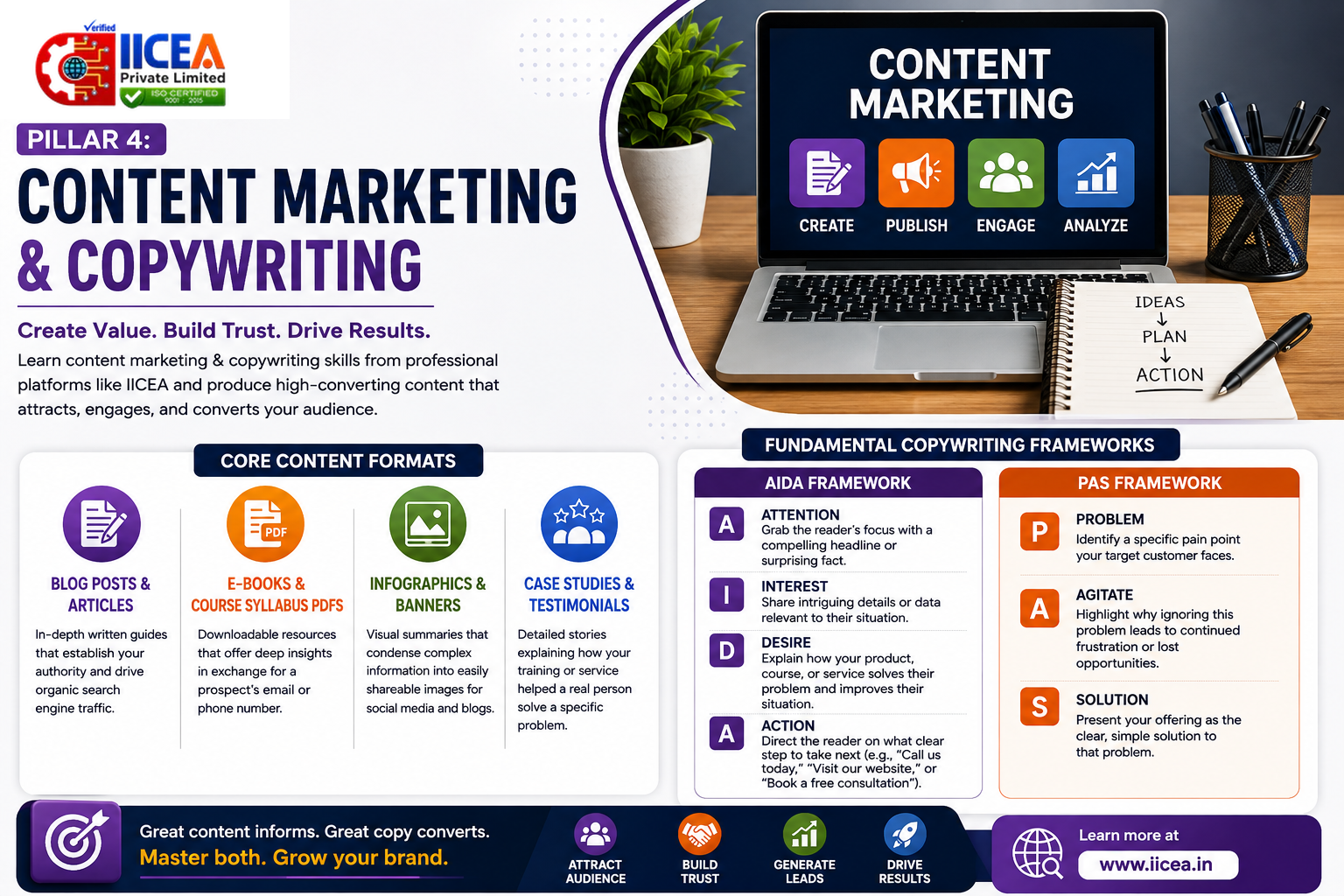
Content marketing is the strategic practice of creating and distributing useful, relevant, and consistent content to attract and retain a clearly defined audience. Rather than pitching your products directly, you deliver value that helps solve your prospective customers' problems. Learning these skills from professional platforms like IICEA allows creators and business owners to produce high-converting material consistently.
Core Content Formats
- Blog Posts & Articles: In-depth written guides (like this one) that establish your authority and drive organic search engine traffic.
- E-books & Course Syllabus PDFs: Downloadable resources that offer deep insights in exchange for a prospect's email address or phone number.
- Infographics & Banners: Visual summaries that condense complex information into easily shareable images for social media and blogs.
- Case Studies & Student Testimonials: Detailed stories explaining how your training or service helped a real person solve a specific problem.
Fundamental Copywriting Frameworks
Whether you are writing an ad title, an email, or a social media caption, structured copywriting formulas keep your messaging clear and persuasive:
The AIDA Framework
- Attention: Grab the reader's focus with a compelling headline or surprising fact.
- Interest: Share intriguing details or data relevant to their situation.
- Desire: Explain how your product, course, or service solves their problem and improves their situation.
- Action: Direct the reader on what clear step to take next (e.g., "Call us today," "Visit our website," or "Book a free consultation").
The PAS Framework
- Problem: Identify a specific pain point your target customer faces.
- Agitate: Highlight why ignoring this problem leads to continued frustration or lost opportunities.
- Solution: Present your offering as the clear, simple solution to that problem.
Pillar 5: WhatsApp & Conversational Marketing
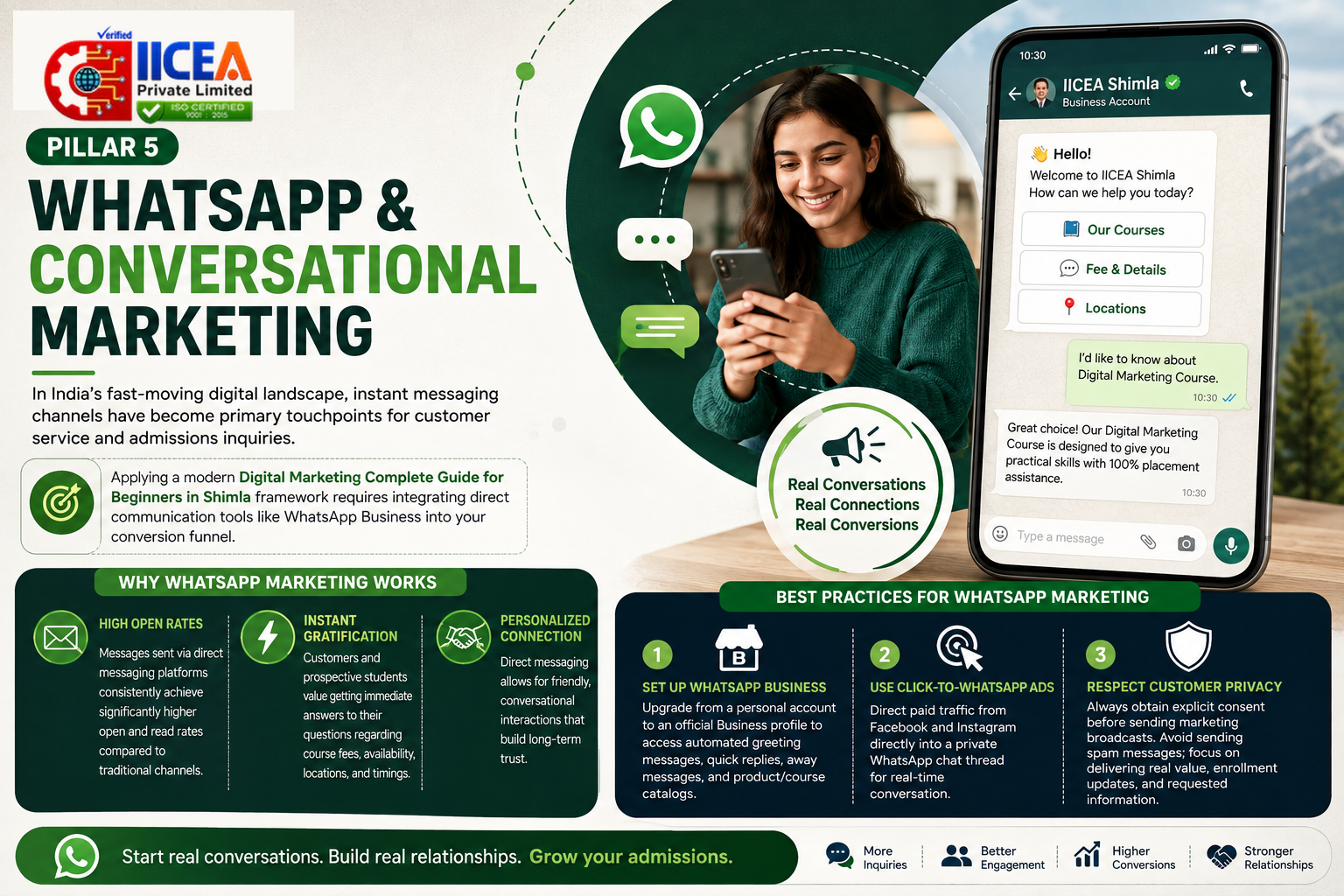
In India's fast-moving digital landscape, instant messaging channels have become primary touchpoints for customer service and admissions inquiries. Conversational marketing focuses on building one-on-one relationships through real-time chat interactions.
Applying a modern Digital Marketing Complete Guide for Beginners in Shimla framework requires integrating direct communication tools like WhatsApp Business into your conversion funnel.
Why WhatsApp Marketing Works
- High Open Rates: Messages sent via direct messaging platforms consistently achieve significantly higher open and read rates compared to traditional channels.
- Instant Gratification: Customers and prospective students value getting immediate answers to their questions regarding course fees, availability, locations, and timings.
- Personalized Connection: Direct messaging allows for friendly, conversational interactions that build long-term trust.
Best Practices for WhatsApp Marketing
- Set Up WhatsApp Business: Upgrade from a personal account to an official Business profile to access automated greeting messages, quick replies, away messages, and product/course catalogs.
- Use Click-to-WhatsApp Ads: Direct paid traffic from Facebook and Instagram directly into a private WhatsApp chat thread for real-time conversation.
- Respect Customer Privacy: Always obtain explicit consent before sending marketing broadcasts. Avoid sending spam messages; focus on delivering real value, enrollment updates, and requested information.
Pillar 6: Web Analytics & Performance Tracking
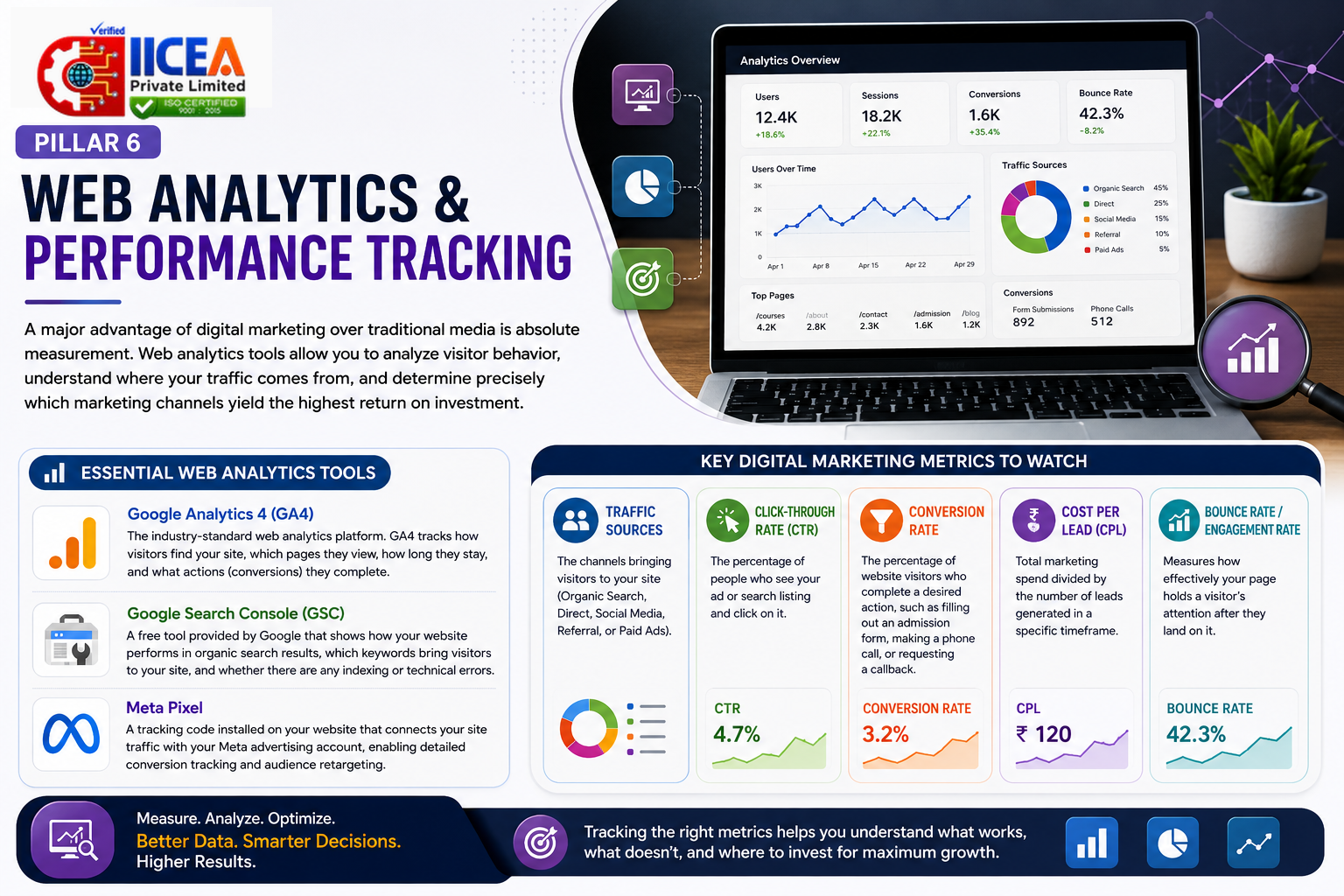
A major advantage of digital marketing over traditional media is absolute measurement. Web analytics tools allow you to analyze visitor behavior, understand where your traffic comes from, and determine precisely which marketing channels yield the highest return on investment.
Essential Web Analytics Tools
- Google Analytics 4 (GA4): The industry-standard web analytics platform. GA4 tracks how visitors find your site, which pages they view, how long they stay, and what actions (conversions) they complete.
- Google Search Console (GSC): A free tool provided by Google that shows how your website performs in organic search results, which keywords bring visitors to your site, and whether there are any indexing or technical errors.
- Meta Pixel: A tracking code installed on your website that connects your site traffic with your Meta advertising account, enabling detailed conversion tracking and audience retargeting.
Key Digital Marketing Metrics to Watch
To evaluate your marketing campaigns effectively, focus on these core performance indicators:
- Traffic Sources: The channels bringing visitors to your site (Organic Search, Direct, Social Media, Referral, or Paid Ads).
- Click-Through Rate (CTR): The percentage of people who see your ad or search listing and click on it.
- Conversion Rate: The percentage of website visitors who complete a desired action, such as filling out an admission form, making a phone call, or requesting a callback.
- Cost Per Lead (CPL): Total marketing spend divided by the number of leads generated in a specific timeframe.
- Bounce Rate / Engagement Rate: Measures how effectively your page holds a visitor's attention after they land on it.
Pillar 7: Modern Trends (AI & Generative Engine Optimization - GEO)
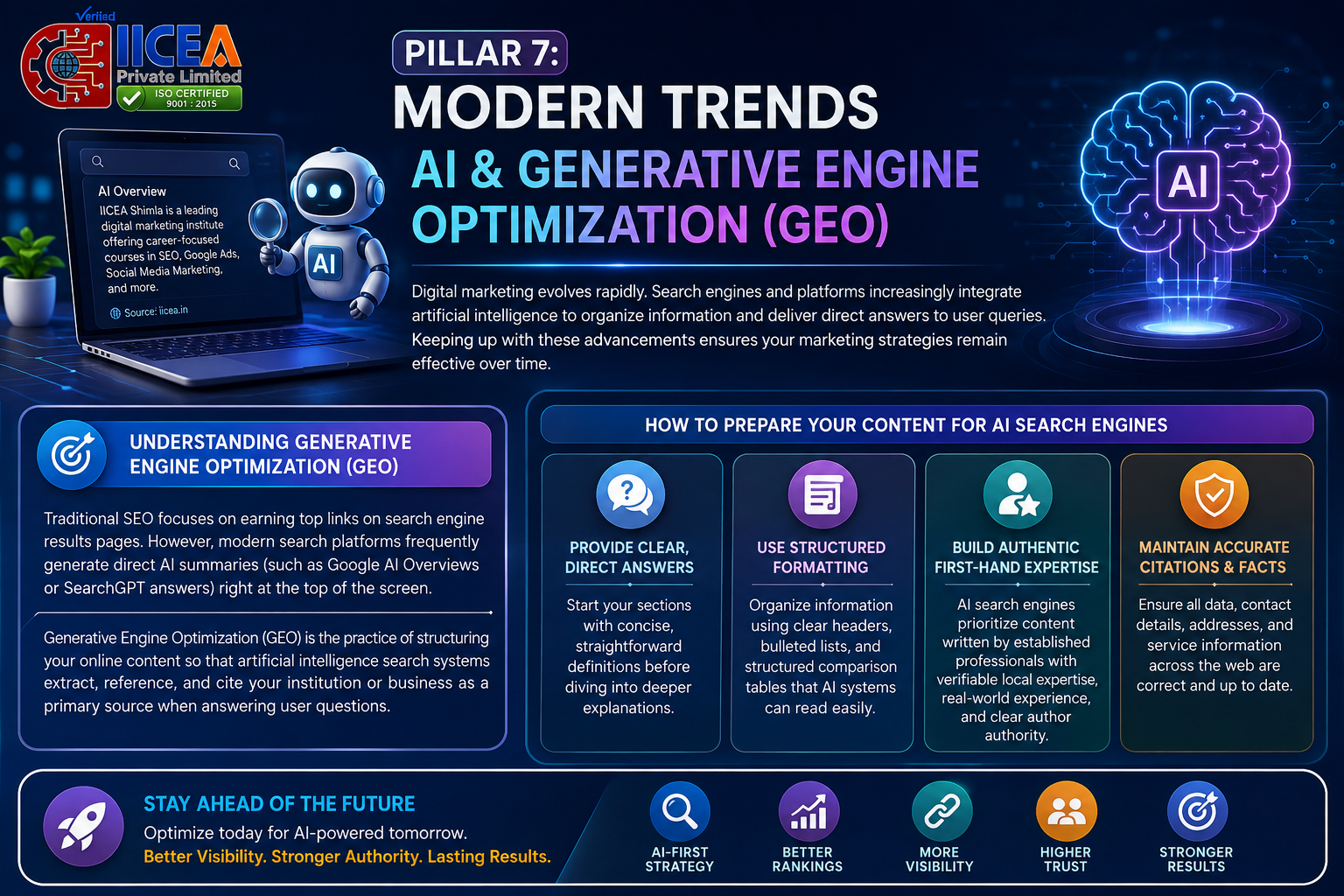
Digital marketing evolves rapidly. Search engines and platforms increasingly integrate artificial intelligence to organize information and deliver direct answers to user queries. Keeping up with these advancements ensures your marketing strategies remain effective over time.
Understanding Generative Engine Optimization (GEO)
Traditional SEO focuses on earning top links on search engine results pages. However, modern search platforms frequently generate direct AI summaries (such as Google AI Overviews or SearchGPT answers) right at the top of the screen.
Generative Engine Optimization (GEO) is the practice of structuring your online content so that artificial intelligence search systems extract, reference, and cite your institution or business as a primary source when answering user questions.
How to Prepare Your Content for AI Search Engines
- Provide Clear, Direct Answers: Start your sections with concise, straightforward definitions before diving into deeper explanations.
- Use Structured Formatting: Organize information using clear headers, bulleted lists, and structured comparison tables that AI systems can read easily.
- Build Authentic First-Hand Expertise: AI search engines prioritize content written by established professionals with verifiable local expertise, real-world experience, and clear author authority.
- Maintain Accurate Citations and Facts: Ensure all data, contact details, addresses, and service information across the web are correct and up to date.
Step-by-Step Actionable Execution Roadmap for Beginners
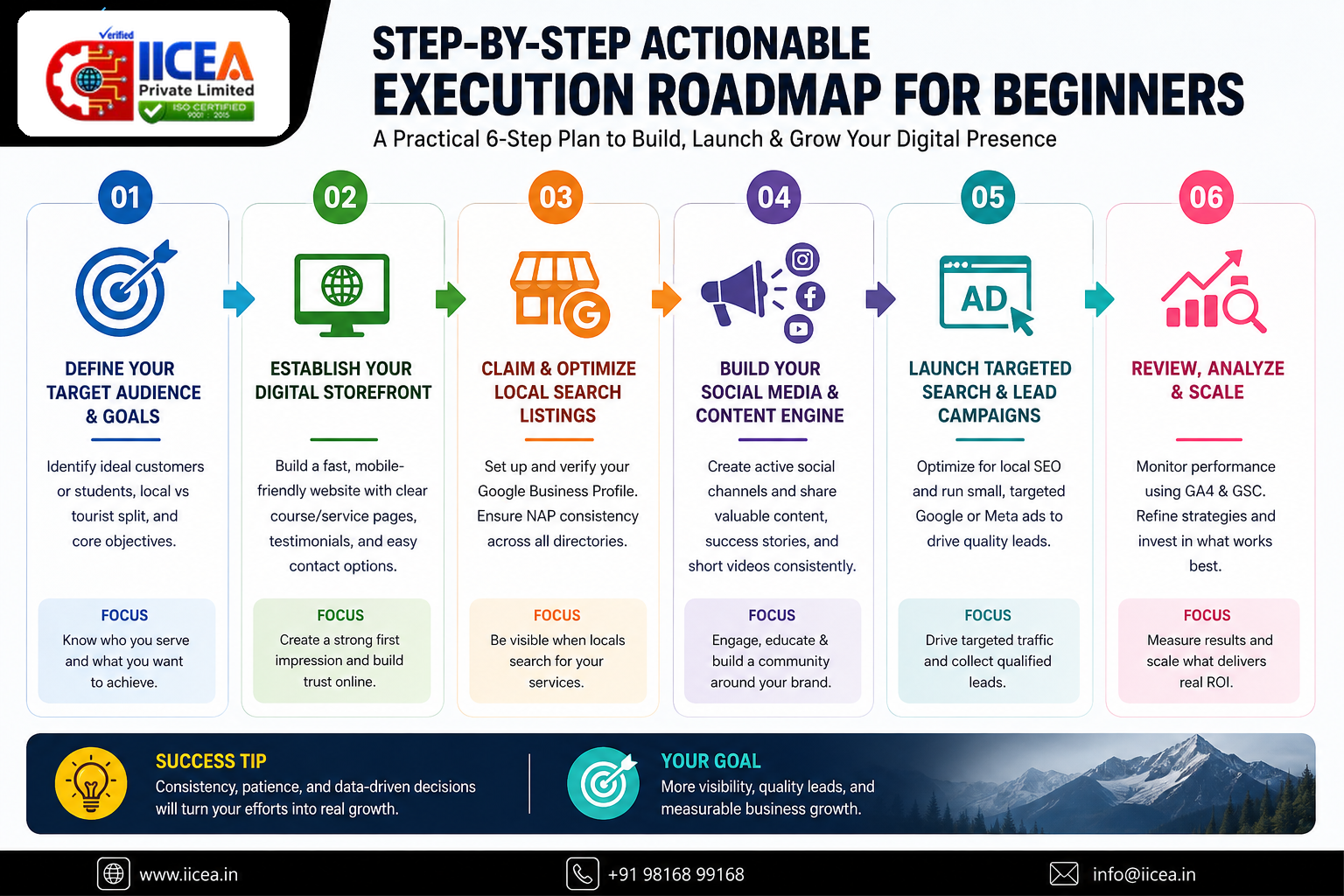
Now that you understand the fundamental pillars of online marketing, here is a practical execution roadmap to help you build and launch your digital strategy systematically.
Step 1: Define Target Audience & Goals
└── Identify ideal customers or students, local vs tourist split, and core objectives.
Step 2: Build & Optimize Your Digital Storefront
└── Establish a fast, mobile-friendly website and set up core course or service pages.
Step 3: Establish Local Search Presence
└── Create and verify Google Business Profile; secure NAP consistency across directories.
Step 4: Launch Content & Social Engine
└── Set up active social channels; publish consistent, helpful content and videos.
Step 5: Implement Search & Paid Advertising
└── Optimize website for local SEO; run small, targeted ad campaigns to collect leads.
Step 6: Measure, Analyze & Scale
└── Review GA4 analytics; double down on high-performing channels and optimize ROI.
Step 1: Define Your Target Audience and Business Goals
Before spending time or money on marketing assets, clarify exactly who you are trying to reach. Are you serving local residents in Shimla, students looking for skill development, or tourists planning a trip? Define specific, measurable goals (e.g., "generate 30 qualified phone inquiries per month" or "increase local website traffic by 50%").
Step 2: Establish Your Digital Storefront
Your website serves as your primary online hub. Ensure it is fast, mobile-responsive, secure, and easy to navigate. Include clear descriptions of your courses or services, prominent contact buttons, student/customer testimonials, and an updated blog section. To see how an optimized, modern digital portal is structured, you can explore the official platform at IICEA
Step 3: Claim and Optimize Local Search Listings
Set up and verify your Google Business Profile listing immediately. Fill in every available detail, including your exact address, operating hours, service options, high-resolution photographs, and phone number.
Step 4: Build Your Social Media & Content Engine
Select one or two primary social media channels where your audience is active. Create a practical content calendar covering educational posts, success stories, and short video reels. Aim for consistency rather than overwhelming volume.
Step 5: Launch Targeted Search and Lead Campaigns
Begin optimizing your site content for high-intent local search queries. When you are ready to accelerate lead generation, launch small, tightly targeted paid ad campaigns on Google or Meta to drive direct inquiries.
Step 6: Review Analytics and Refine Your Strategy
Consistently monitor your performance metrics using tools like Google Analytics 4 and Google Search Console. Identify which channels drive actual business inquiries, refine underperforming pages, and allocate more of your budget to strategies that produce measurable returns.
Conclusion
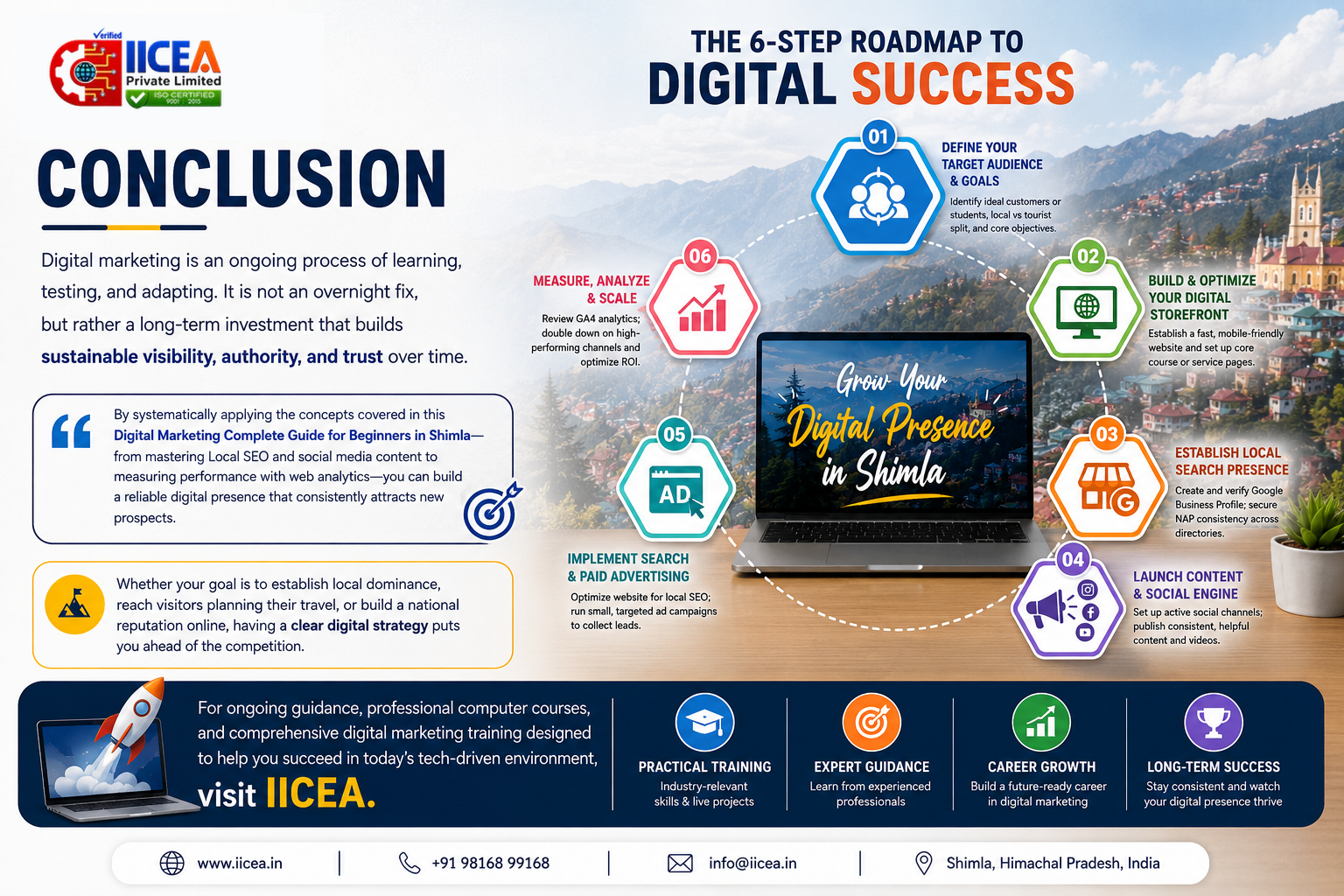
Digital marketing is an ongoing process of learning, testing, and adapting. It is not an overnight fix, but rather a long-term investment that builds sustainable visibility, authority, and trust over time.
By systematically applying the concepts covered in this Digital Marketing Complete Guide for Beginners in Shimla—from mastering Local SEO and social media content to measuring performance with web analytics—you can build a reliable digital presence that consistently attracts new prospects.
Whether your goal is to establish local dominance, reach visitors planning their travel, or build a national reputation online, having a clear digital strategy puts you ahead of the competition.
For ongoing guidance, professional computer courses, and comprehensive digital marketing training designed to help you succeed in today's tech-driven environment, visit . Take the first step today, stay consistent with your learning and execution, and watch your digital presence thrive.
Frequently Asked Questions
1. What is digital marketing and how does it work?
Digital marketing is the process of promoting a business, service, or course through online channels such as Google, social media, websites, email, and mobile apps. It helps you reach the right audience, communicate with potential customers, and measure how well your marketing is performing.
2. Why is digital marketing important for businesses in Shimla?
Digital marketing helps Shimla businesses reach people when they are actively searching online. Whether you run a hotel, cafe, local shop, travel business, coaching center, or training institute, a strong online presence can help you attract local customers as well as tourists planning their visit to Shimla.
3. Is digital marketing suitable for beginners in Shimla?
Yes. Beginners can start with the basics and gradually learn areas such as SEO, Local SEO, social media marketing, content marketing, paid advertising, WhatsApp marketing, analytics, and AI-based search strategies. The key is to learn the fundamentals first and then apply them step by step.
4. What is Local SEO and why is it important in Shimla?
Local SEO helps businesses appear when people search for services near a particular location. For a Shimla business, it can improve visibility for location-based searches and help potential customers discover your business through Google Search and Google Maps.
5. How can I improve my Google Business Profile for local SEO?
Start by claiming and verifying your Google Business Profile, keeping your name, address, and phone number consistent, selecting accurate business categories, collecting genuine customer reviews, and regularly uploading quality photos of your business.
6. Which social media platforms are best for digital marketing?
There is no single platform that works for every business. Instagram can be useful for visual and lifestyle businesses, Facebook can help with local communities and advertising, LinkedIn works well for professional and B2B audiences, while YouTube is useful for educational and long-form video content.
7. What is the difference between SEO and PPC advertising?
SEO focuses on improving your website's organic visibility in search results, while PPC provides paid visibility through advertisements. SEO generally takes time to build, whereas PPC can provide immediate visibility when campaigns are properly targeted.
8. How much should a beginner spend on digital marketing?
There is no fixed budget that works for every business. A beginner can start with a small, controlled budget, test different campaigns, measure the results, and gradually increase spending on channels that generate useful leads or conversions.
9. What type of content should I create for digital marketing?
Useful content can include blog posts, educational articles, videos, infographics, e-books, case studies, customer or student testimonials, and social media posts. Instead of only promoting your product or service, focus on answering real questions and solving problems your audience faces.
10. How can WhatsApp marketing help a local business?
WhatsApp marketing allows businesses to communicate directly with potential customers in real time. It can be useful for answering questions about fees, availability, locations, timings, services, and admissions while creating a more personal customer experience.
11. What is Google Analytics 4 (GA4) used for?
Google Analytics 4 helps you understand what visitors do on your website. You can use it to see how people find your website, which pages they visit, how long they stay, and which actions or conversions they complete.
12. What is Google Search Console and why should beginners use it?
Google Search Console helps you understand how your website performs in Google's organic search results. It can show which search queries bring visitors to your site and help you identify indexing or technical issues that may affect your visibility.
13. What digital marketing metrics should I track?
Some important metrics include traffic sources, click-through rate (CTR), conversion rate, cost per lead (CPL), and bounce rate or engagement rate. These numbers help you understand which marketing activities are working and where your strategy needs improvement.
14. What is Generative Engine Optimization (GEO)?
Generative Engine Optimization, or GEO, is the practice of structuring online content so AI-powered search systems can understand, extract, reference, and potentially cite the information when answering users' questions. Clear answers, structured content, accurate information, and genuine expertise are important parts of this approach.
15. How can I start digital marketing as a beginner in Shimla?
Start by defining your target audience and goals, build a fast and mobile-friendly website, establish your Google Business Profile, create useful social media and content, test targeted advertising, and regularly review your analytics. You do not need to master everything at once—build your strategy step by step and improve it based on real results.